


What brings people in
These are the things new mums most often come to us with.
- Recovering from the birth: feeling depleted, sore or slow to get your energy back
- Sleep: exhausted, but finding it hard to sleep when you get the chance
- Feeding difficulties: including mastitis, alongside your GP
- Wrist and thumb pain: often called “mummy thumb” or De Quervain’s, from lifting and feeding
- Back, neck and shoulder pain: from feeding, carrying and settling
- Low mood and stress: alongside support from your GP
Still pregnant? See our supporting pregnancy page.
Why your recovery matters too
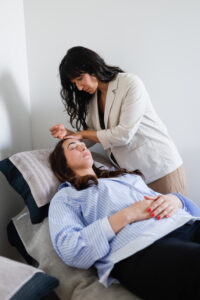
Pregnancy and birth take a lot out of you, and the months after ask even more.
Broken sleep, feeding and carrying a baby all day can leave you depleted, sore and short on patience. It’s easy to put your own recovery last.
We look at how you’re recovering and what’s wearing you down most, and treat that.
We also give practical advice on rest, eating well and looking after your body while you look after your baby.
What to expect
1. Discover
We go through your pregnancy, the birth and how you’re going now. You’ll have treatment in that first session, and you’ll leave with a plan.
2. Recover
A short course of treatment. We check in every visit and tell you straight if something should be checked by your GP.
3. Whole again
Once you feel more like yourself, come back when you need to, or just call when something flares.
What treatment involves
Your practitioner will choose from the following, depending on what you need. Most plans combine two or three.
- Acupuncture. Fine, single-use needles placed at specific points. Most people find it far gentler than they expected.
- Chinese herbal medicine. Prescribed for you individually. Tell us if you’re breastfeeding and we’ll take it into account.
- Nutrition. Practical advice on eating well to rebuild your energy.
- Lifestyle advice. Rest, posture and simple ways to look after your body through feeding and carrying.
Alongside your GP and maternal health nurse
Keep your usual check-ups, and tell your GP or maternal health nurse that you’re seeing us.
A fever, or a breast that is hot, red and painful, should be checked by your GP the same day. If you’re feeling very low, anxious or not coping, please talk to your GP. You can also call the PANDA National Helpline on 1300 726 306.
Who you’ll see
Every practitioner at the clinic is AHPRA registered in acupuncture and Chinese herbal medicine.
Kerrie Dick
Compassionate and practical, with time for women whose symptoms haven’t been taken seriously elsewhere. Particular interest in pregnancy and stress.
Michelle McNeill
Trained in Melbourne with a hospital internship in Taipei. Builds movement, meals and daily habits into her treatment plans. Particular interest in women’s health, sleep and mental health.
Nick Conquest
Holds a Master of Traditional Chinese Medicine with a focus on chronic illness and women’s health. Particular interest in musculoskeletal pain.
Adriana Dalic
A grounded, whole-body approach that looks for the root of the problem. Particular interest in stress and the nervous system.
Questions people ask
When can I start after the birth?
Whenever you feel ready. Many women come in during the first few months, and it is never too late.
I am breastfeeding. Is that a problem?
No. Tell us that you’re breastfeeding and we’ll take it into account in everything we suggest.
Does acupuncture hurt?
The needles are very fine, far thinner than the ones used for injections. You may feel a brief pinch, then a dull, heavy or warm sensation. Most people find it relaxing.
Can I claim on private health insurance?
Rebates may be available through private health funds with extras cover, depending on your policy. Check with your fund, and see our consultation fees.